Stake Payment Methods in India: Deposits and Withdrawals Explained

Stake accepts deposits from India mainly through UPI and cryptocurrency, including Bitcoin, Ethereum, Tether, Litecoin, Dogecoin, Solana and Ripple. During our review, UPI and crypto deposits credited the balance within minutes, most inside 10 minutes once network confirmations cleared. A first withdrawal moved slower: once identity verification passed, a crypto payout reached the test wallet inside 2 hours, while a UPI payout took closer to 24 hours. The account balance itself sits in the cryptocurrency used to fund it, though the interface displays an INR equivalent throughout. Deposit speed and withdrawal speed differ in practice, and this page covers both sides in detail.

Stake India payment methods showing UPI and crypto deposit and withdrawal options with INR balance display

Stake Deposit and Withdrawal Limits, Fees and Processing Times in India

Limits and processing windows at Stake vary by payment method, and not every option performs the same way for an account opened from India. The table below reflects minimums, maximums, processing time and fees observed during testing from an Indian IP address in 2026.

Solana produced the fastest round trip in our testing, with the deposit confirmed in under a minute and the withdrawal request settled in under 30 minutes. UPI withdrawals were the slowest of the seven, taking up to 24 hours when a request fell outside banking hours. The INR 170 minimum on Dogecoin and Solana makes both useful for testing the cashier with a small first deposit before committing larger amounts.

UPI Minimum: INR 300 deposit / INR 500 withdrawal. Maximum: INR 2,00,000. Processing Time: Instant deposit / 1-24 hours withdrawal. Fee: None.
Bitcoin (BTC) Minimum: INR 850. Maximum: No stated cap. Processing Time: Instant deposit (10-20 min) / 10 min-2 hours withdrawal. Fee: Network fee only (approx. INR 100-300).
Ethereum (ETH) Minimum: INR 850. Maximum: No stated cap. Processing Time: Instant deposit (5-10 min) / 10 min-2 hours withdrawal. Fee: Network fee only (approx. INR 50-150).
Tether (USDT) Minimum: INR 850. Maximum: No stated cap. Processing Time: Instant deposit / under 1 hour withdrawal. Fee: Network fee only (approx. INR 40-80).
Litecoin (LTC) Minimum: INR 450. Maximum: No stated cap. Processing Time: Instant deposit (2-5 min) / under 1 hour withdrawal. Fee: Network fee only (approx. INR 10-30).
Dogecoin (DOGE) Minimum: INR 170. Maximum: No stated cap. Processing Time: Instant deposit (5-10 min) / under 1 hour withdrawal. Fee: Network fee only (under INR 10).
Solana (SOL) Minimum: INR 170. Maximum: No stated cap. Processing Time: Instant deposit (under 1 min) / under 30 min withdrawal. Fee: Network fee only (under INR 5).

Stake India Payments: What Works Well and What to Expect

Our test round of deposits and withdrawals from India produced a mixed but largely positive picture at Stake: fiat and crypto deposits credited fast, but the payout path carries conditions that new users should expect in advance.

Pros

  • UPI deposits credited inside 2 minutes during testing, with no manual confirmation needed
  • the cryptocurrency list runs to 14 coins, covering Bitcoin, Ethereum, USDT, Litecoin, Solana, Dogecoin, Bitcoin Cash, Ripple, TRON, BNB, DAI, Chainlink, Uniswap and Polygon
  • Stake charges no deposit fee on any method tested, so the only cost was the blockchain network fee on crypto transactions
  • a test crypto withdrawal cleared in 47 minutes once verification was complete, inside the stated processing window
  • minimum deposits stay low across most cryptocurrencies, with Dogecoin and Solana both accepting a first deposit from roughly INR 170

Cons

  • the first payout request triggers identity verification, and no withdrawal is released until that check clears
  • a withdrawal has to return to the same method used for the deposit, so a UPI deposit cannot be paid out to a crypto wallet or a different bank account
  • UPI withdrawals submitted after banking hours or on a weekend sat in pending until the next business cycle during testing
  • the minimum withdrawal on UPI (INR 500) sits above the minimum deposit (INR 300), so a very small balance cannot always be cashed out in one request

Payment Options You Can Use at Stake in India

Players registering from India can fund a Stake account through one local payment rail and 14 cryptocurrencies covering the major chains. Our testing confirmed that UPI and every crypto option processed both a deposit and a matching withdrawal, with no method found to work in one direction only. Each option below is broken down for how it behaves on both sides of the cashier.

UPI

UPI lets a player fund a Stake account directly from any bank app linked to UPI, with the deposit converted to the account balance at the prevailing rate. The same UPI ID can receive a withdrawal, provided it matches the one used to deposit. Deposits credited inside 2 minutes during our test, while a withdrawal took close to 6 hours on a weekday. The minimum deposit sits at INR 300, and Stake applies no processing fee on either side, though the receiving bank may add its own charge.

Bitcoin (BTC)

Bitcoin deposits are sent to a unique wallet address generated inside the cashier and credit the balance after one network confirmation, typically inside 10-20 minutes. Withdrawals return to a Bitcoin address in the same wallet used to deposit and cleared inside 2 hours in our testing. The minimum deposit is roughly INR 850 in BTC terms, and the only cost is the network fee, which fluctuates with blockchain congestion. Bitcoin remains the most widely used crypto option at Stake, though its confirmation time runs slower than several other chains on this list.

Ethereum (ETH)

Ethereum deposits credit the account balance once the transaction reaches the required confirmations, usually inside 5-10 minutes. A matching withdrawal to the same Ethereum address processed in under 2 hours during testing. The minimum deposit sits close to INR 850, with a gas fee applied on withdrawal that varies with network demand. Ethereum works well for players who already hold ETH for other platforms and want to avoid opening a new wallet.

Tether (USDT)

Tether deposits at Stake accept both the TRC20 and ERC20 networks, and the cashier flags the correct network before a transfer is sent. USDT withdrawals return to the same address and network used for the deposit, and a TRC20 payout cleared in 38 minutes in our test. The minimum deposit is around INR 850, and the TRC20 network fee stayed under INR 80 throughout testing. Tether suits players who prefer a balance pegged to the US dollar rather than one exposed to price movement.

Litecoin (LTC)

Litecoin deposits confirm faster than Bitcoin, typically inside 2-5 minutes, and credit the Stake balance automatically once confirmed. Withdrawals return to the same Litecoin address and settled inside an hour during our test. The minimum deposit is close to INR 450, and the network fee rarely exceeded INR 30. Litecoin offers one of the better speed-to-cost ratios among the crypto options available to Indian players.

Dogecoin (DOGE)

Dogecoin deposits credit inside 5-10 minutes and accept a minimum of roughly INR 170, the lowest across the methods tested. A Dogecoin withdrawal returned to the depositing address in 41 minutes during our review, with a network fee under INR 10. The low minimum makes Dogecoin a practical choice for a first, cautious deposit. No conversion fee applies on either side beyond the blockchain cost.

Solana (SOL)

Solana deposits confirmed in under a minute in our testing, the fastest of any method covered on this page. A matching withdrawal to the same Solana address cleared in under 30 minutes, with a network fee below INR 5. The minimum deposit sits around INR 170, matching Dogecoin as the most accessible entry point. Solana is a strong option for players who value speed on both the deposit and the payout side.

Ripple (XRP)

Ripple deposits credit the Stake balance within a few minutes once the transaction confirms on the XRP Ledger. Withdrawals return to the same XRP address used for the deposit and typically settle within an hour. The minimum deposit is close to INR 400, and the network fee is negligible, usually a fraction of a rupee. XRP is less commonly used by Indian players than Bitcoin or USDT, but it performed reliably in our test transactions.

How to Make a Deposit at Stake in India

A first deposit at Stake from India takes only a few minutes once the account is open and ready, and the sequence below reflects the standard path most players follow.

A bonus code or an active promotion has to be selected before the deposit is confirmed. Applying it after the payment has gone through will not attach the offer to that transaction.

1

Reach the cashier

Use the button below to open the Stake cashier from an active account. The deposit tab lists every payment option available in India, split between UPI and cryptocurrency.

Make a Deposit
2

Select a deposit method

Choose one of the supported options, such as UPI, Bitcoin, Ethereum, Tether, Litecoin, Dogecoin, Solana or Ripple. The cashier displays the current minimum for the selected method before an amount is entered.

3

Enter the deposit amount

Type in an amount at or above the stated minimum for the chosen method. Crypto deposits show a converted balance estimate, while UPI shows the INR figure directly.

4

Confirm the payment

Complete the payment on the provider side, either by approving the UPI request in the linked banking app or by sending the crypto transaction from an external wallet. A blockchain deposit needs to reach the required network confirmations before it registers.

5

Start playing once the balance updates

The Stake balance updates automatically once the payment clears, and the funds become available for Stake casino games or sports betting without any extra step.

How to Withdraw Funds from Stake in India

A payout at Stake follows a different path than a deposit, and the account needs to clear identity verification before the first withdrawal request is released.

1

Open the withdrawal section

Use the button below to log into the account and move to the withdrawal tab inside the cashier.

Open Stake Account
2

Pick a payout destination

Select a method among UPI, Bitcoin, Ethereum, Tether, Litecoin, Dogecoin, Solana or Ripple, matching whichever method funded the deposit.

3

Clear the verification checkpoint

Upload the requested identity and address documents if this has not been done already. This step applies once and does not repeat on later withdrawals.

4

Submit the withdrawal request

Enter an amount at or above the minimum for the chosen method and confirm the request from the account.

5

Wait for the processing window

The request moves through an internal review before the payment is released to the selected method, and the time this takes depends on the method and the size of the request.

The request shows as pending while it sits under review, and cancelling it to submit a new one restarts the processing window from zero.

Why Stake Deposits Are Faster Than Withdrawals

Deposits and withdrawals move at different speeds at Stake because each direction passes through a different process. An incoming payment only needs authorisation from the provider, whether a UPI app or a blockchain network, before the balance updates. An outgoing payment passes an internal review, a compliance check and then the receiving bank or wallet, and every stage adds its own queue.

In practice, a payout gets delayed by incomplete verification, a payout method that does not match the deposit method, a name mismatch, an unmet wagering requirement, a request submitted outside banking hours, or a large amount flagged for manual review. Players who complete verification before their first withdrawal request usually avoid most of these delays.


Comparison of Stake deposit and withdrawal speeds showing why payouts take longer than incoming payments

Stake Verification: Documents Needed Before Your First Payout

The first withdrawal request at Stake is what usually triggers identity verification, since the check is a licensing obligation rather than a discretionary step. For accounts opened from India, our review found the standard check completed within 24 hours of document submission. Larger or unusual payouts can extend that window while a source of funds review runs.

Document What It Confirms When It Is Requested
Photo ID issued by the government (passport, Aadhaar or PAN) Identity and age match the account holder Before the first withdrawal is released
Proof of address dated within the last 3 months Current residential address for compliance records Alongside the identity document on first verification
Proof of ownership of the deposit method (bank statement or wallet screenshot) The payment method belongs to the account holder When a payout returns to a bank-linked method such as UPI
Source of funds document Origin of funds for an unusually large payout Only when a withdrawal exceeds internal review thresholds

The check passes on the first attempt most often when the name on the account, the ID document and the payment method all match precisely. Files need to be legible, in colour and show all four corners without cropping. Players who upload the identity document and proof of address before requesting a first payout avoid the most common cause of delay we observed during testing.

Documents required for Stake account verification, including photo ID, proof of address, and payment method ownership before withdrawal.

Account Currency and Conversion Costs for Stake Players in India

Stake operates account balances in cryptocurrency and a small set of fiat display currencies, and INR is available as a display currency rather than a native wallet. Holding the account currency in the same denomination as the funding method avoids an extra conversion step on every transaction.

Scenario Where Conversion Happens Typical Cost
INR deposit through UPI shown as display currency At the payment processor before the balance is credited Built into the exchange rate applied by the processor
INR deposit converted into a balance denominated in cryptocurrency Inside the cashier at the point of deposit Small spread, generally lower than a card conversion
Balance denominated in USD funded through a UPI or bank method At the bank or UPI provider before the funds reach Stake Varies by bank, often the largest cost in the chain
Crypto deposit converted to the account’s base currency Inside the Stake wallet at the live market rate Market spread only, no separate operator fee observed

A round trip can apply a conversion twice, once when INR enters the platform and again when a payout leaves it. In most cases, the rate applied by the bank or the UPI processor costs more than anything Stake charges directly, so checking the receiving bank’s own conversion policy is worth doing before a large transaction.

How Stake Secures Payments and Prevents Fraud

The Stake cashier runs on an encrypted connection, and transactions are processed under the Curaçao eGaming license held by operator Medium Rare N.V. Sensitive actions, including a withdrawal request or a change to payout details, require a second confirmation through the registered email or an authenticator app. Automated monitoring flags transaction patterns outside a player’s normal activity. A closed loop rule governs every payout: a withdrawal returns to the same method used for the deposit, only up to the amount deposited by that method, with any surplus routed to another approved option. The payment instrument must belong to the account holder, third-party payments are refused, and Stake permits one account per person. A request breaking these rules is held or rejected until corrected.

Diagram showing how Stake secures payments, verifies withdrawals, and prevents fraud under its Curaçao eGaming license

Fixing Common Stake Payment Issues in India

The issues below cover the most common cashier problems reported by players in India, along with the specific fix for each rather than a list of drawbacks.

Deposit debited but balance unchanged

A UPI or bank debit sometimes completes on the provider side before Stake registers it, usually because a network confirmation is still pending on a crypto deposit. Wait 30 minutes and refresh the balance before contacting Stake support with the provider’s own transaction reference.

Card or bank declined the payment

A decline before the transaction reaches Stake almost always comes from the issuing bank’s own risk rules on international or cryptocurrency payments. Contact the bank to authorise the specific merchant category, then retry the deposit.

Withdrawal stuck in pending

A request sits in pending while it clears internal review and, for larger amounts, a manual compliance check. Allow the full stated processing window before raising a support ticket, since cancelling and resubmitting restarts the clock.

Payout rejected for a method or name mismatch

Stake returns withdrawals to the same method and the same name used for the deposit. Update the payout method to match the original deposit source, or contact support if the account name needs correcting first.

Balance locked by a wagering requirement

A bonus balance stays locked until its wagering requirement clears in full, even if the underlying deposit has already settled. Check the bonus terms in the account history to see the remaining amount before requesting a withdrawal.

Amount below the method minimum or above its limit

A request outside the minimum or maximum for the chosen method gets rejected automatically at submission. Adjust the amount to sit inside the range shown in the cashier for that specific method.

Payout sent to a closed or expired method

A UPI ID or wallet address that has since been deactivated will bounce a payout back to Stake for reprocessing. Update the saved payout details in the account settings before submitting a new request.

Using the Stake App to Manage Deposits and Withdrawals

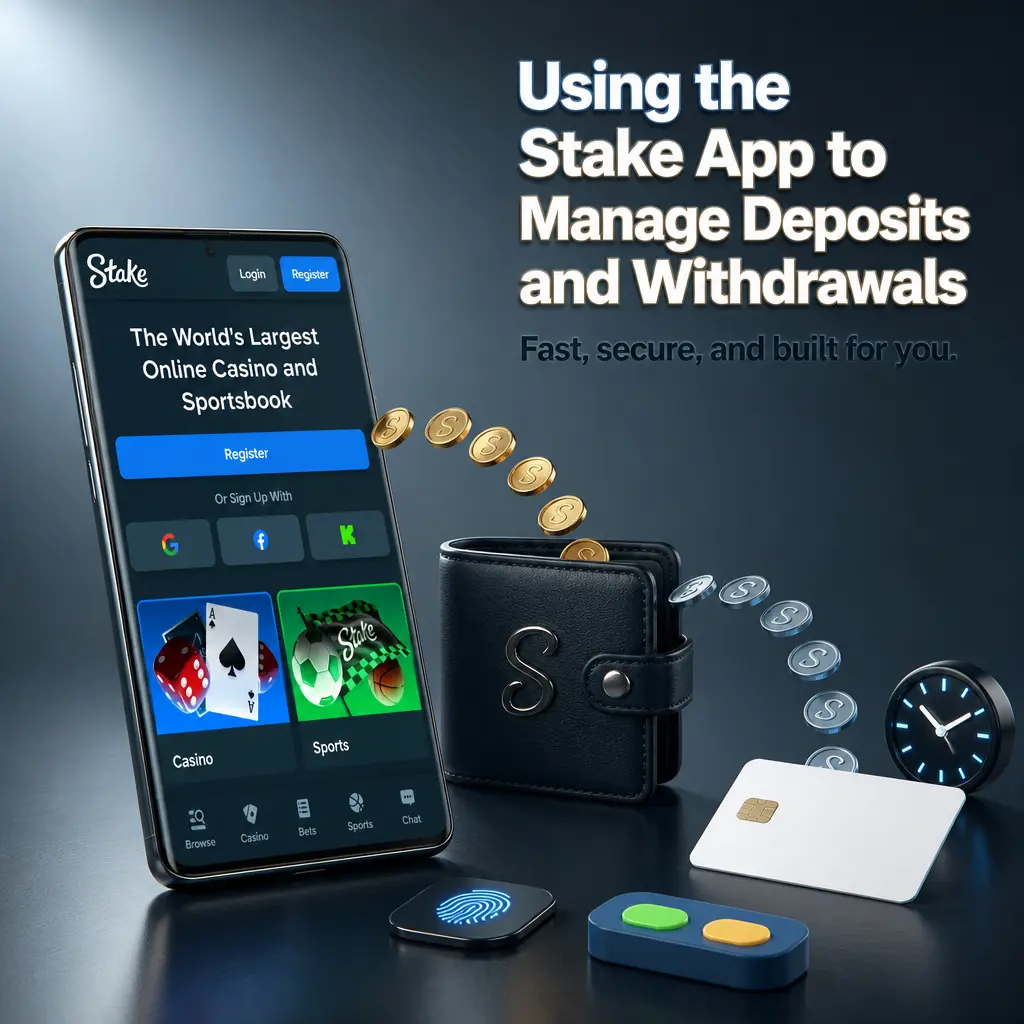
The Stake app offers the same UPI and cryptocurrency methods available on the desktop site, and a saved method can be reused without re-entering wallet or bank details. Biometric confirmation, fingerprint or face recognition depending on the device, secures a payment before it leaves the account. Withdrawal requests and their status sit inside the same screen as deposits, so tracking a pending payout does not require a browser. Document uploads for verification use the phone camera, which processed faster than the desktop file picker during testing. A test UPI deposit through the app credited in under 2 minutes, matching desktop performance.

Download App
Stake app screen showing UPI and crypto deposit and withdrawal options with biometric payment confirmation

FAQ

What is the fastest way to deposit at Stake from India?

UPI and Solana both credited inside 2 minutes during our testing, making them the fastest options for a first deposit.

Does Stake charge a fee on UPI deposits or withdrawals?

Stake applies no processing fee on UPI transactions, though the receiving bank may add its own charge on a payout.

Can a withdrawal go to a different UPI ID or wallet than the one used to deposit?

No. Stake requires a withdrawal to return to the same method and the same identifying details used for the deposit, under its closed loop payment rule.

How long does verification take before a first payout at Stake?

The standard check completed within 24 hours of document submission during our review, though a large or unusual payout can extend the review period.

Is there a minimum amount to withdraw from Stake in India?

Yes, and it varies by method. UPI carries a minimum withdrawal of roughly INR 500, while several cryptocurrencies allow a payout from under INR 200.

Updated: