



Mines at Stake: The Gem and Bomb Grid Explained for India

Mines is a Stake Originals title. It runs inside the Stake online casino lobby for players in India, built around a 5×5 grid of 25 covered tiles. Before each round starts, the player picks how many bombs, between 1 and 24, sit hidden beneath the tiles. Every safe tile opened afterward raises the running multiplier, while a single bomb ends the round and forfeits the stake. The player controls both the mine count and the moment to stop, since no clock runs on any decision. The game runs in a free demo as well as a cash mode, and cash balances used on Mines in India count toward the 7,000,000 INR Weekly Lottery.

Mines at Stake: 5x5 grid game with hidden bombs, rising multipliers, and cash play for Indian players

Mines Game Specifications at Stake

The figures below come from the game information panel inside Mines, part of the Stake game library available to accounts registered in India. The maximum multiplier depends on the mine count selected before a round begins, so the ceiling shown applies to the highest setting.

Our research indicates the bet range narrows once bonus funds are active on the account, a detail covered in the promotions section below.

Software provider Stake Originals
RTP 99%
Volatility Adjustable, from low at 1 to 3 mines to extreme at 20 to 24 mines
Minimum bet per round INR 10
Maximum bet per round Up to INR 8,00,000, subject to account and VIP tier limits
Maximum win multiplier Up to approximately 24,700x, reached at 24 mines on the final tile
Demo mode Yes, free credits, no deposit needed
Provably fair Yes, verifiable through server seed, client seed and nonce
Mobile support Full browser version plus an Android app download and a progressive web app for iOS

Mines Strengths and Limitations for Players in India

The Mines format at the Stake casino gives the player direct control over risk and timing, though the mechanic carries structural limits that suit some session styles better than others. Based on our analysis, the strengths sit mostly in flexibility, while the drawbacks come from the same randomness that makes the game work.

Pros

  • The mine count sets risk directly, from a single bomb to 24 across the 25 tile grid
  • The multiplier for the next tile shows before it is opened, so the payout is known ahead of the decision
  • A round can be banked at any point after the first safe tile, with no minimum pick count
  • No clock runs on any decision, so a tile can be considered for as long as needed
  • The minimum stake of INR 10 keeps the cost of testing different mine counts low
  • Every completed grid can be checked through provably fair verification after the round ends

Cons

  • Bomb positions are fixed the moment the round starts, so no opening order or tile pattern carries better odds than another
  • The full stake is lost the instant a bomb is revealed, regardless of how many gems were banked mentally before it
  • Bonus terms at Stake often cut the contribution of grid games like Mines toward wagering, and some offers cap the stake per round while bonus funds are active
  • The repeat cycle of opening a tile and deciding again can extend a session well past its intended length, since each round takes seconds to resolve

How to Play Mines at Stake: A Step by Step Guide

A round of Mines is a series of stop or continue decisions with no clock attached to any of them. The sequence below covers one round from opening the game to banking a return, from the first tile through to cash out.

1

Open Mines from the game lobby.

Use the button below to open the Stake website, then search “Mines” in the games library or find it under the Originals category.

Play Mines
2

Choose the mine count.

Select how many bombs, from 1 to 24, sit hidden across the 25 tile grid before the round starts.

3

Enter the stake and start the round.

Type the amount to wager in INR, or the equivalent in the account currency, then confirm to lock in the mine count and generate the grid.

4

Open tiles one at a time.

Tap or click each tile to reveal a gem, and watch the multiplier for the next tile update after every safe pick.

5

Cash out to bank the return.

Press cash out at any point after the first safe tile to settle the round at the current multiplier, or continue to the next tile at the higher risk shown.

7,000,000 INR Weekly Lottery and Bonus Terms on Mines

The Stake India promotions calendar includes a 7,000,000 INR Weekly Lottery, with entries drawn from the casino balance wagered across the site, Mines included. A qualifying deposit and an account verified for India determine eligibility, and winners are selected at random from the pool of eligible entries each week. Outside the lottery, bonus terms at Stake generally reduce the wagering contribution of grid games such as Mines, sometimes to a small fraction of the stake, and active bonus funds often cap the amount wagered per round. In our assessment, that per round cap makes bonus wagering slower to clear on Mines than on standard slot titles.

Get a Bonus
Stake India's 7,000,000 INR Weekly Lottery and bonus wagering terms explained for Mines game players

Mines on the Stake Mobile App and Mobile Browser

On a phone, the 5×5 grid scales to fill a portrait screen without shrinking individual tiles, so each one stays large enough for an accurate tap. The mine selector sits above the grid, the stake field and the cash out control anchor the bottom of the screen, and the multiplier for the next tile stays visible in a strip above the tiles at all times. Stake serves the mobile experience through a browser version and a downloadable Android application, since native app stores do not list real money gambling apps. If the connection drops mid round, the grid stays open on the account and resumes once the app reconnects.

Download App
Mines game on Stake mobile app showing 5x5 grid, mine selector, stake field, and cash out button on portrait screen.

How the Free Demo Version of Mines Works

A free account created through the Stake official website opens the demo without a deposit requirement, though a login is still needed since practice play sits behind registration. The demo runs on virtual credits with no cash value, and the balance resets rather than being available to withdraw. It works well for seeing how steeply the multiplier climbs at different mine counts and how fast a round with 20 or more mines tends to end. A demo run reveals nothing about future cash rounds, because bomb positions are generated fresh for every single round.

Mines Rules and How the Grid Behaves

The grid is decided the instant a round starts, and every choice after that point is a decision to stop or continue. The mechanics behind that cycle are set out below.

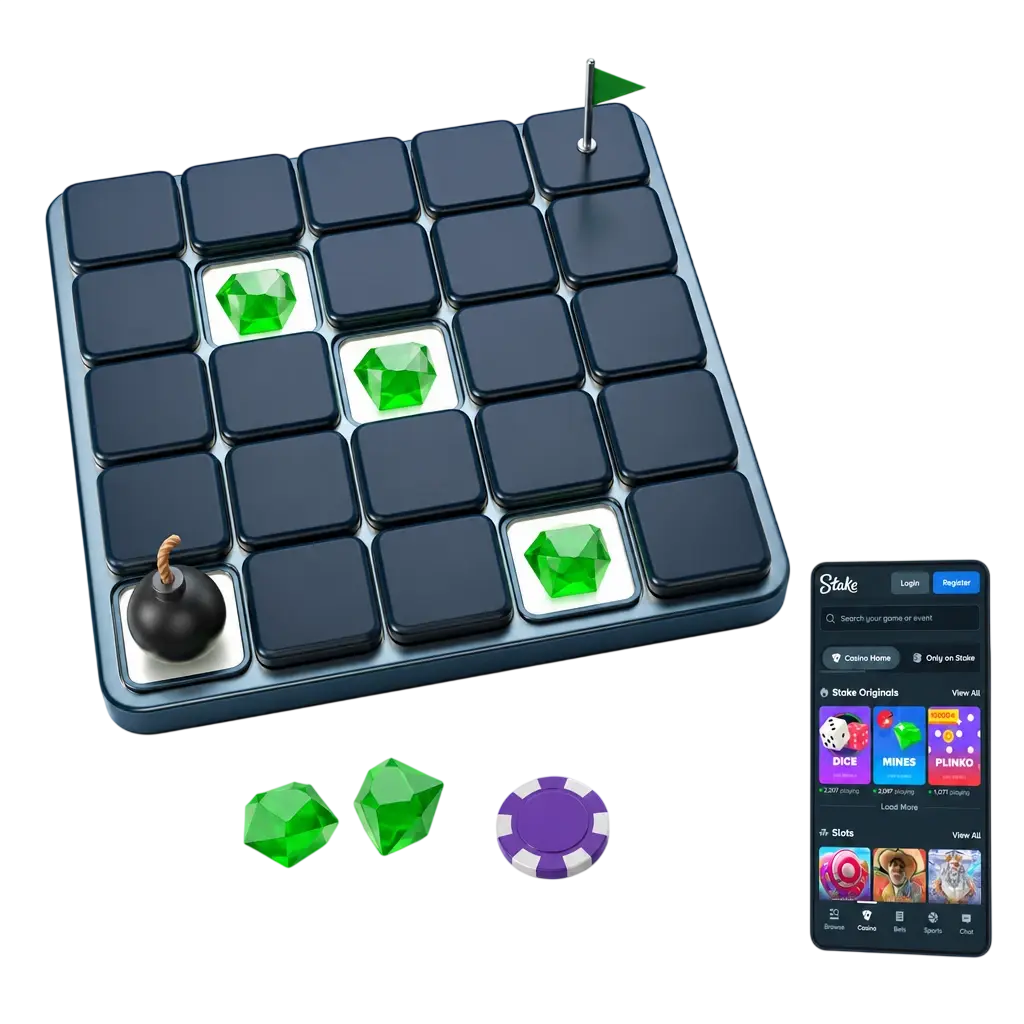
Diagram of Mines' 5×5 grid showing gem and bomb tiles, illustrating multiplier growth and cash-out mechanics.

How the Grid and a Round Work

Mines uses a fixed 5×5 grid of 25 covered tiles. Once the stake is confirmed, a chosen number of bombs is placed at random beneath the tiles, and the rest hide gems. A gem tile raises the multiplier and keeps the round active when opened, while a bomb tile ends the round and forfeits the entire stake immediately, regardless of how many gems were already revealed.

Mine Count as the Core Risk Control

The mine count is the primary risk control in Mines, adjustable from 1 to 24 across the 25 tiles. A higher count shortens the expected round but raises the multiplier paid for each safe tile, while a lower count allows longer runs at much smaller steps per tile. The setting locks in once a round begins and can only be changed before the next one starts.

How the Multiplier Grows per Safe Tile

The multiplier recalculates after every safe tile, since the pool of unopened tiles shrinks while the number of hidden bombs stays fixed. Each further pick therefore carries more risk than the one before it and pays a larger step. The value for the next tile displays on screen before it is opened, so the decision to continue is made with that figure already known.

How a Round Ends and Pays Out

A cash out settles the round at the multiplier reached at that moment, and the return credits to the balance right away. A round cannot be partly banked, only fully cashed out or carried forward to the next tile. An unfinished round stays open on the account until it resolves through a cash out or a bomb. Stake also offers an autobet mode that runs a set number of rounds automatically at a fixed mine count and cash out target.

Provably Fair Verification of Each Grid

Every Mines round can be checked through the provably fair system built into Stake. Bomb placement derives from a server seed combined with a client seed and a round counter, and the hashed version of the server seed publishes before the round begins. A comparison between the revealed server seed and that hash afterward confirms the grid was fixed in advance and not altered by tile choice. The seed settings sit in the fairness panel inside the game interface.

Mines Strategy Approaches and Risk Settings

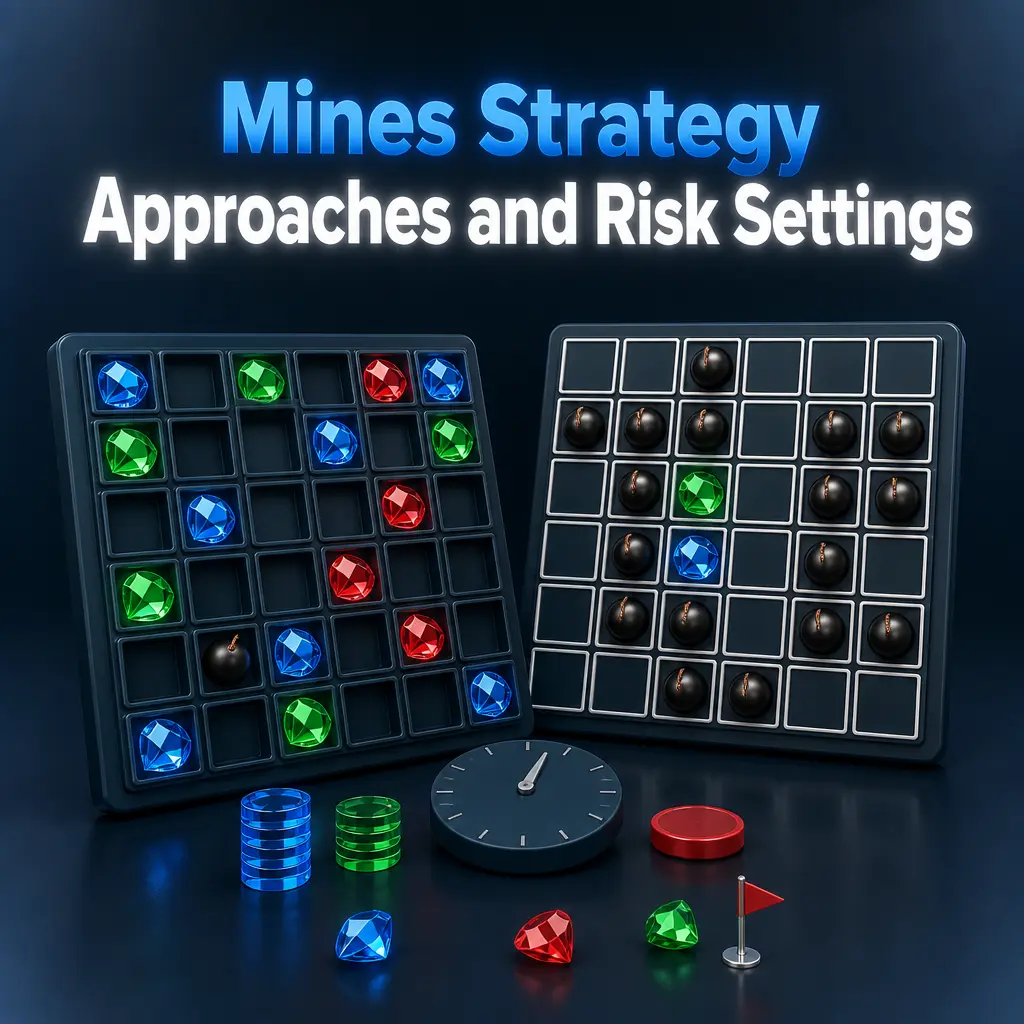
Bomb positions on every Mines grid are randomised before the first tile opens, and no tile position or opening sequence carries better odds than another. The approaches below change how risk and variance spread across a session rather than improving the underlying odds. None of them turns a Stake bet on Mines into a guaranteed profit.

Guide to Mines strategy on Stake covering mine count settings, fixed pick targets, cashout timing, and bankroll risk management.

Few Mines and Long Runs of Safe Tiles

A mine count of 1, 2 or 3 leaves most of the 25 tile grid safe, so most rounds allow several picks and a return above the stake comes up often. Each tile at this setting adds a small step to the multiplier, so reaching a meaningful return takes a long run of successful picks, and a bomb late in that run still costs the full stake. The house edge built into the RTP stays the same regardless of the mine count chosen.

Many Mines and Short High Multiplier Rounds

A mine count above 15 pays a steep multiplier from the first safe tile onward, since so few tiles remain safe. The trade off is a high chance of hitting a bomb on any single pick, and most rounds at this setting finish with nothing banked. This configuration needs a larger round budget to absorb a run of consecutive losses, and the gap between successful rounds follows no predictable pattern.

Fixed Pick Counts Instead of Open Ended Rounds

A fixed number of tiles decided before a round starts, then cashed out at that count regardless of how the run feels, addresses the tendency to take one extra pick after a strong sequence rather than the odds themselves. The target pick count works best when set against the mine count chosen for that round, rather than carried over from a previous setting with different risk.

When to Bank a Round

Since the multiplier for the next tile shows before it opens, every decision to continue is made with the cost of that choice already visible. That figure can be treated as a question of whether the current return is worth risking in full, rather than a target to beat, which keeps the decision grounded in the number on screen. A banked return is final, while an open round remains exposed to the next tile.

Stake Sizing and Session Limits

A small fixed share of the session balance per stake, a round count and a loss limit decided before starting, and a steady stake after a loss rather than a raised one, reflect standard bankroll practices that apply to Mines as much as any other casino game. A round with no time pressure can still stretch a session far longer than planned. The Stake account settings include a deposit limit, a loss limit and a time out tool for managing that exposure.

Payment Methods for Mines Players at Stake in India

A casino balance for Mines tops up through the same cashier used across the Stake official website. During our review, UPI transfers and 15 cryptocurrencies, including Bitcoin, Ethereum, Tether, Litecoin, Solana, Dogecoin, Bitcoin Cash, Ripple, TRON, Binance Coin, DAI, Chainlink, Uniswap and Polygon, all processed correctly for an account set to India. Deposits credit to the balance once the network or payment processor confirms the transaction, and the first withdrawal on any account normally releases only after identity verification completes.

UPI Transfers

UPI transfers process instantly, with a minimum deposit around INR 300 and no deposit fee. Withdrawals routed back to UPI typically settle within 24 hours once verification clears, and daily withdrawal totals follow the limit set for the account tier.

Bitcoin Deposits and Withdrawals

A Bitcoin deposit needs at least 3 network confirmations before crediting, usually 30 to 60 minutes, with a minimum deposit equivalent to roughly INR 800. Withdrawals process without a platform side fee, though the Bitcoin network mining fee still applies, and payouts under the account’s verified limit generally arrive within a few hours.

Tether and Stablecoin Payments

Tether (USDT), available on multiple networks including TRC20 and ERC20, carries a minimum deposit near INR 400 and settles within minutes on the TRC20 network. Withdrawals in USDT avoid the price swings tied to Bitcoin or Ethereum, keeping the payout amount easier to predict against the INR balance shown before cash out.

Other Supported Cryptocurrencies

Ethereum, Litecoin, Solana, Dogecoin, Bitcoin Cash, Ripple, TRON, Binance Coin, DAI, Chainlink, Uniswap and Polygon are all accepted for deposit and withdrawal, each with a minimum deposit near the INR 200 to INR 500 range depending on the network fee at the time. Withdrawal speed depends mainly on network congestion, with most of these coins settling within 10 to 30 minutes of approval.

Similar Grid and Instant Games at Stake

The Stake casino lobby carries several other titles built on a similar stop or continue idea, differing mainly in how the risk is configured and how a round ends.

Plinko

A ball drops through a pin field into one of several multiplier slots, with risk set by row count and volatility level rather than a hidden bomb grid.

up to 99%
Stake Originals

Dragon Tower

Players climb a tower of tiled levels, choosing one safe tile per level instead of an entire grid, with the mine count swapped for a level difficulty setting.

97%
Stake Originals

Hilo

A card based format where the multiplier grows by guessing whether the next card is higher or lower, rather than selecting a tile position on a grid.

up to 99%
Stake Originals

Keno

Numbers are drawn from a pool after a spot count is chosen, so the payout depends on how many chosen numbers match the draw rather than avoiding a hidden bomb.

up to 99%
Stake Originals

Crash

A multiplier climbs on a rising curve until it stops at a random point, and the only decision is when to cash out before the curve ends.

99%
Stake Originals
Open Casino

Why Mines Draws Players in India on the Stake Platform

Beyond the grid mechanic itself, several platform level factors, shared with the Stake betting site’s sportsbook, shape how Mines plays out for an account based in India.

Risk Set Directly by the Mine Count

A single setting moves Mines from a low variance format at 1 or 2 mines to a high variance one near 24 mines. That range lets one title suit a cautious session budget or an aggressive one without switching to a different game.

No Time Pressure on Any Decision

A round with no clock attached means a tile can be considered for as long as needed before a tap. That design keeps the game workable even on a slow mobile connection, where a timing based format like Crash could misfire on a delayed load.

Low Minimum Wager and Local Currency

An account balance held in INR removes a currency conversion step at the cashier, and the INR 10 minimum stake per round keeps the cost of testing several mine counts low across a short session.

Fast Deposits and Withdrawal Turnaround

UPI deposits credit within minutes on the Stake website, and cryptocurrency deposits credit after network confirmation, typically inside an hour. Once an account clears verification, withdrawals back to UPI or crypto wallets generally settle within a day, based on processing times observed during our review.

Support and Responsible Play Tools

Live chat support stays reachable through the website while a session runs, alongside an email channel for account and payment queries. Deposit limits, loss limits, session reminders and self exclusion sit inside the account settings for players who want to structure their exposure to Mines or any other game.

FAQ

Is Mines rigged at Stake, or can each round be checked?

Every Mines round runs on a provably fair system. The bomb layout comes from a hashed server seed published before the round starts, so the layout can be checked against that hash once the round ends.

What is the lowest stake to play Mines in India?

The minimum stake per round sits at INR 10, low enough to test multiple mine counts across a short session without a large outlay.

Does the demo version of Mines need a deposit?

Anyone who wants to play Stake Mines in demo mode can do so without a deposit, though an account login is needed. The demo runs on virtual credits that reset and carry no cash value.

How many mines can be placed on the grid?

Between 1 and 24 mines can be hidden across the 25 tile grid, with the setting locked once a round begins.

Does a bonus wager count fully on Mines?

Bonus terms at Stake generally reduce the contribution of grid games like Mines toward wagering requirements, so clearing a bonus through Mines alone typically takes longer than through a standard slot title.

Updated: